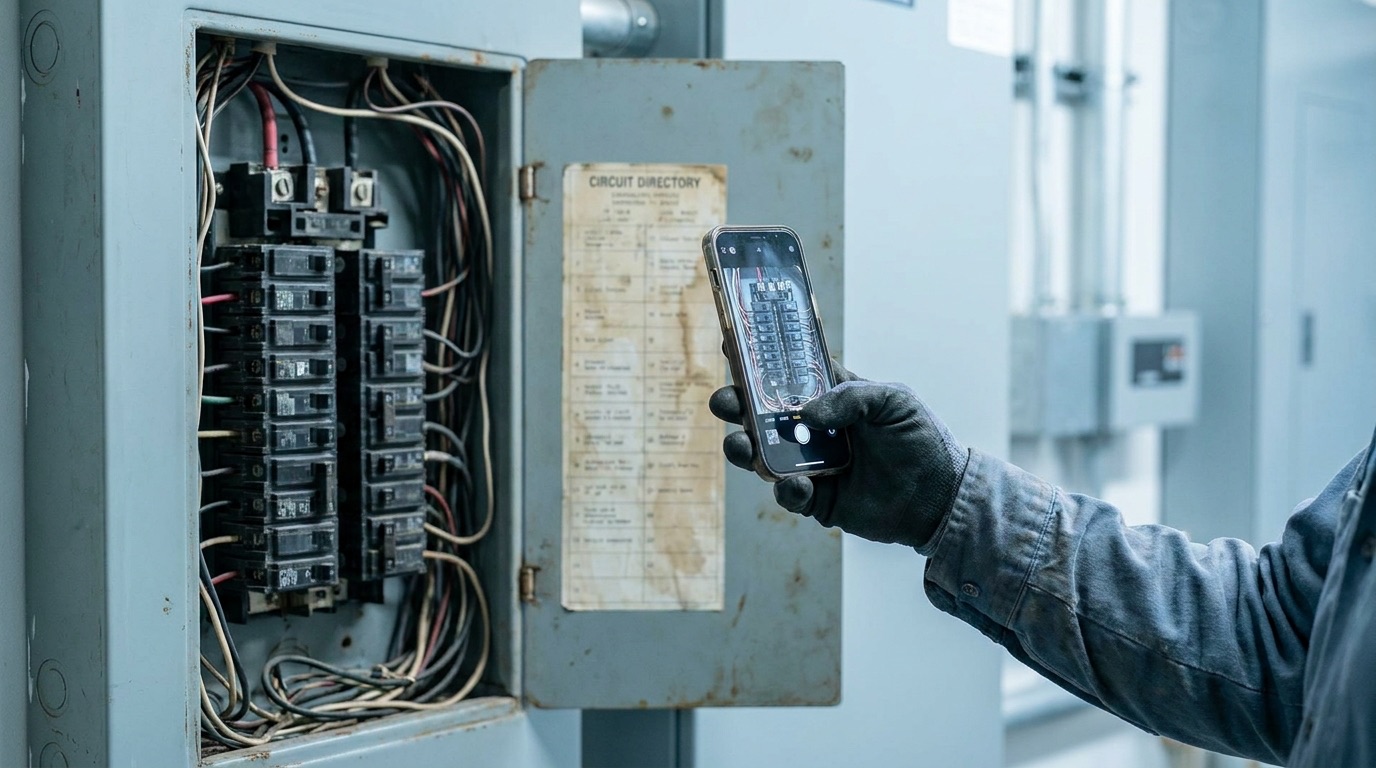
Most capacity questions don’t stall on hard engineering. They stall on missing information — a week of back-and-forth emails trying to pin down what the service even is. The fastest way to get a real answer about whether your site can take chargers or new equipment is to show up with the right five photos.
Here’s what to capture, and why each one matters. (A safety note up front: never open energized electrical gear yourself. Photograph what you can see with covers on, and have a qualified electrician handle anything behind a dead front.)
1. The main service rating
The single most important number is what your service is rated for. Find the main breaker and photograph the amperage stamped on its handle — 200 A, 400 A, 800 A. If there’s no single main, the meter and service-entrance gear tell the story. This sets the ceiling everything else is measured against.
2. The panel directory
The typed or handwritten circuit directory inside the panel door says what’s actually on the service — HVAC, lighting, process equipment, the big motors. A clear shot of the labels turns guesswork about your load into a list someone can reason about.
3. The open panel — if a pro is present
With a qualified electrician, a photo of the panel with the dead front removed shows the busbar rating, how full the breaker positions are, and whether there are open spaces for new circuits. This is what tells you whether new chargers can even land in the existing gear or need a new panel. Don’t do this one yourself.
4. The nameplates of your biggest loads
The equipment that drives your peak — rooftop units, compressors, chillers, large motors — carries a nameplate with its voltage and current draw. Photographing the two or three largest helps explain the shape of your demand and where it spikes.
5. The utility bill
Finally, a recent utility bill — specifically the page showing the demand (kW) line and your rate schedule. It’s the closest thing to a measurement most sites already have on hand, and it frames both the capacity question and the demand-charge one.
What the photos can — and can’t — do
Photos and a bill get you a fast, well-grounded first read: what the service is rated for, roughly how loaded it looks, and where the headroom probably is. What they can’t do is pin down your peak demand — the 15-minute interval maximum the utility and AHJ ultimately want under NEC 220.87. The evidence you already have tightens the headroom range; where it’s thin, a short metering study or field verification settles it.
Ready to try it? Send your photos with a free capacity check and we’ll turn them into a conservative headroom range, the missing evidence, and a permit-ready approval path.
Always treat electrical equipment as live and dangerous. Only a qualified person should open or work inside panels. This is general information, not engineering or legal advice; figures and examples here are illustrative.